Submit


ESD electrostatic protection failure? It might be that you have chosen the wrong ESD diode! -ASIM
 2025.08.26 00:00:00
 201
201





ESD electrostatic protection failure? It might be that you have chosen the wrong ESD diode!
您Does the product fail frequently in ESD tests? Even with the addition of ESD protection diodes, the problem still persists? The problem often does not lie in the protection plan itself, but in the incorrect selection of components. This article will, from an engineering practice perspective, deeply analyze the five common pitfalls of improper ESD selection and provide proven solutions to help you pass the electrostatic protection test at one go.
Why do ESD devices still fail even after being added?
Many engineers believe that as long as an ESD diode is connected in parallel at the port, they can rest easy. However, reality is often cruel. According to a large number of rectification cases, the fundamental reason why products experience restarts, damage or performance degradation during testing often lies in the mismatch between the selection of ESD protection diodes and the circuit design. Selecting the wrong component not only fails to provide protection but may even become a new point of failure.
Five Common selection mistakes and their solutions
一、The working voltage (VRWM) matching is incorrect
- Problem phenomenon: Abnormal circuit function, signal distortion, or ESD devices conducting during normal operation, resulting in excessive leakage current.
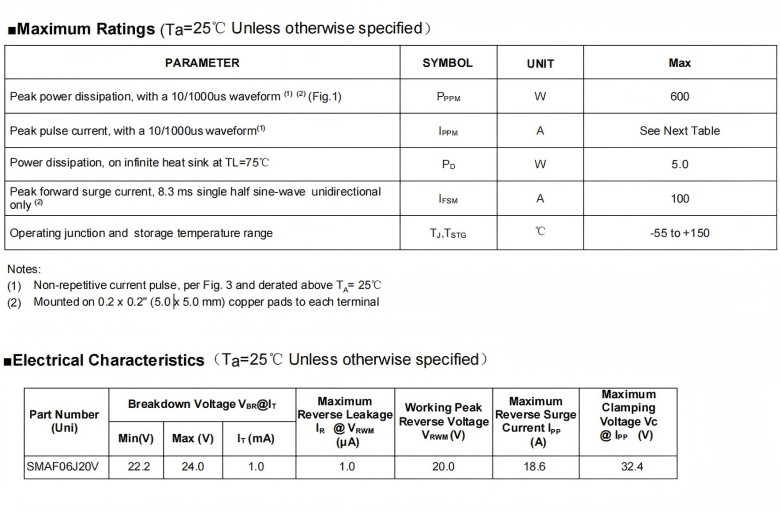
- Root cause analysis: The reverse cut-off voltage (VRWM) of the ESD device must be greater than or equal to the maximum operating voltage of the protected line. If the VRWM is too low, the device will enter a conducting state during normal operation, affecting the normal operation of the circuit.
- Solution: Precisely measure the maximum voltage of the signal line (including surges and fluctuations), and ensure that the VRWM value of the selected ESD diode is higher than this voltage. For instance, for a 5V circuit, a model with VRWM ≥ 5V should be selected, such as 5V, 5.5V or 6V.
二、The clamping voltage (VC) is too high
- Problem phenomenon: The ESD diode did operate, but the chip was still punctured and damaged.
- Root cause analysis: This is the most common cause of failure. The clamping voltage (VC) of an ESD diode refers to the voltage generated across its terminals when discharging amplification current (such as Ipp=8A). If this voltage exceeds the maximum peak voltage that the pins of the protected IC can withstand, the high voltage will still be transmitted into the chip, causing damage.
- Solution: Check the Datasheet of the core IC to determine its absolute maximum withstand voltage. Select ESD devices with a VC value far lower than this withstand voltage. The lower the clamping voltage, the better the protection effect.
三、The junction capacitance (Cj) is ignored
- Problem phenomenon: After adding ESD protection to high-speed signals (such as USB3.0, HDMI, MIPI), problems such as decreased signal integrity, waveform distortion, and increased data bit error rate occur.
- Root cause analysis: The PN junction of an ESD diode will have an inherent junction capacitance. On high-speed signal lines, excessively high junction capacitance (such as several pF) can form a low-pass filter with the line impedance, severely attenuating high-frequency signals and damaging signal integrity.
- Solution: Select ESD protection devices with ultra-low junction capacitance for high-speed data interfaces. According to the document, manufacturers such as Asem Technology offer a series of products with junction capacitance as low as 0.3pF or less, specifically designed for high-speed interfaces like USB3.1 and HDMI 2.0.
四、The peak pulse current (Ipp) is insufficient
- Problem phenomenon: After being subjected to several impacts, the ESD diode itself gets damaged (short circuit or open circuit) and loses its protective function.
- Root cause analysis: The peak pulse current (Ipp) capacity of the selected device is insufficient to withstand the ESD impact energy specified in the test standards (such as IEC 61000-4-2). The device overheated and burned out under the effect of overcurrent.
- Solution: Based on the protection level that the product needs to meet (such as contact ±8kV, air ±15kV), estimate the possible peak current and select a model with sufficient margin in Ipp value.
五、Improper PCB layout and grounding
- Problem phenomenon: The device selection is correct, but the protective effect is still not satisfactory.
- Root cause analysis: The discharge ground of ESD devices must be complete... It must be placed on the main line of the signal line and not on the branch line. An incomplete grounding path can generate a huge parasitic inductance, resulting in an excessively high clamping voltage. However, placing the device in the branch cannot provide an effective low-impedance path.
- Solution:
- Layout: Place the ESD diode as close to the port as possible and discharge the ESD pulse immediately after it enters the circuit board.
- Routing: Position it on the main channel of the signal.
- Grounding: Use short and thick traces to connect to the full ground plane (refer to the ground plane), and avoid using long and thin traces to reduce parasitic inductance.
Conclusion
ESD protection is a systematic project and is by no means as simple as "placing a diode". Incorrect selection is the main cause of protective failure. By avoiding the above five major traps and comprehensively considering voltage, current, capacitance and layout, you can select a truly matching "golden shield" for your product, significantly enhancing its reliability and easily passing all the strict electrostatic tests.
Act Now: If you are struggling with ESD test failures, it is advisable to re-examine your protection plan or contact a professional technical support team for diagnosis. This is often the fastest way to solve the problem.
 Previous