Submit


What is an eye diagram? A comprehensive guide to the function and principle of eye diagrams - ASIM Electronics
 2025.11.17 00:00:00
 393
393





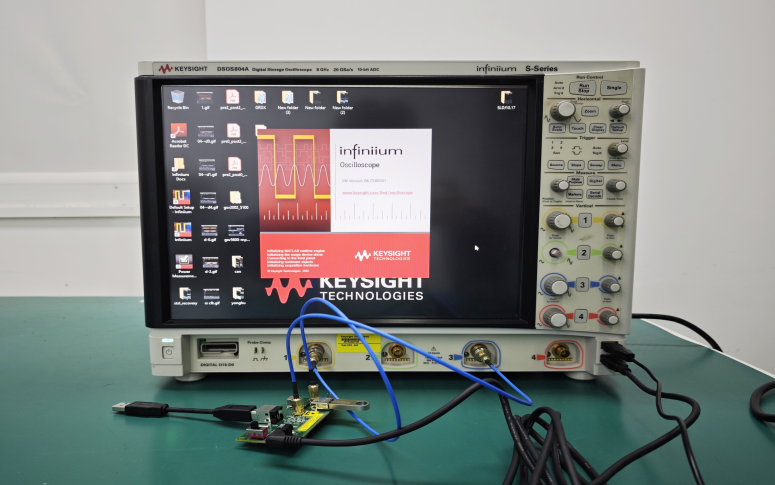
Recently, our laboratory has introduced a set of eye diagram testing equipment. Today, let's take a look at what an eye diagram is? Its function and principle
一、Basic knowledge of eye diagrams
The analysis of eye diagrams is one of the keys to the signal integrity analysis of digital systems. An eye diagram is a graphic displayed by the accumulation of a series of digital signals on an oscilloscope. Therefore, eye diagram analysis is the core of signal integrity analysis in high-speed interconnection systems. In addition, this graph can also be used to adjust the characteristics of the receiving filter to reduce inter-symbol interference and improve the transmission performance of the system.
二、What is an eye diagram
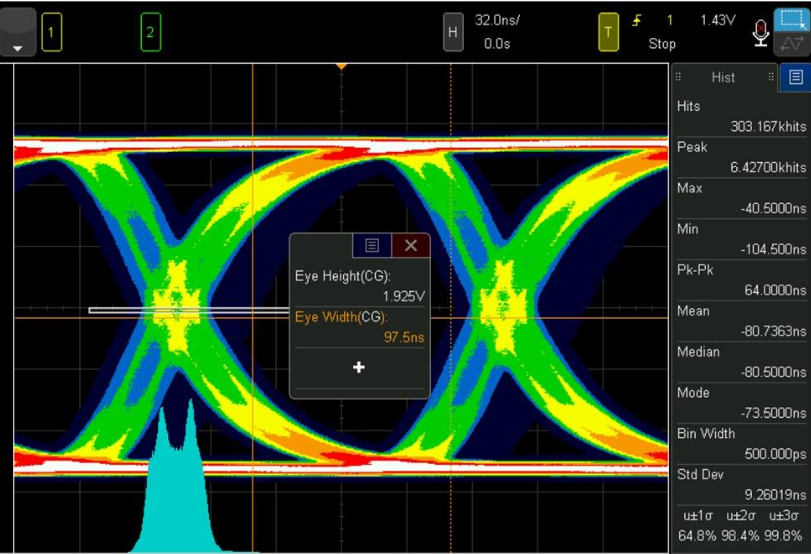
An Eye Diagram is the result of accumulating and superimposing the bits of a collected serial signal in the form of afterglow. The shape of the superimposed graphic looks very similar to an eye, hence the name eye diagram. The eye diagram contains rich information. From the eye diagram, the influence of inter-symbol crosstalk and noise can be observed, which reflects the overall characteristics of the digital signal and thereby estimates the superiority or inferiority of the system.
The size of the "eyes" in the eye diagram that are open reflects the strength of inter-symbol crosstalk. The larger the "eye" is opened and the more upright the eye pattern is, the smaller the inter-symbol crosstalk will be. Conversely, it indicates greater inter-symbol crosstalk.
In the figure: The eye height in the eye diagram represents noise; Wide eyes represent shaking.
三、The principle and function of eye diagrams
The eye diagram is actually the display of a series of different binary codes of a digital signal accumulated on the oscilloscope screen according to a certain rule. Simply put, since the oscilloscope has the afterglow function, as long as all the captured waveforms are superimposed and accumulated separately every three bits, the eye diagram is thus formed.
The eye diagram formed by eight combinations of bit transitions and their superpositions
Eye diagrams are one of the most commonly used ways to view jitter. There are a total of 8 possible combinations of bit transitions (see the figure below).
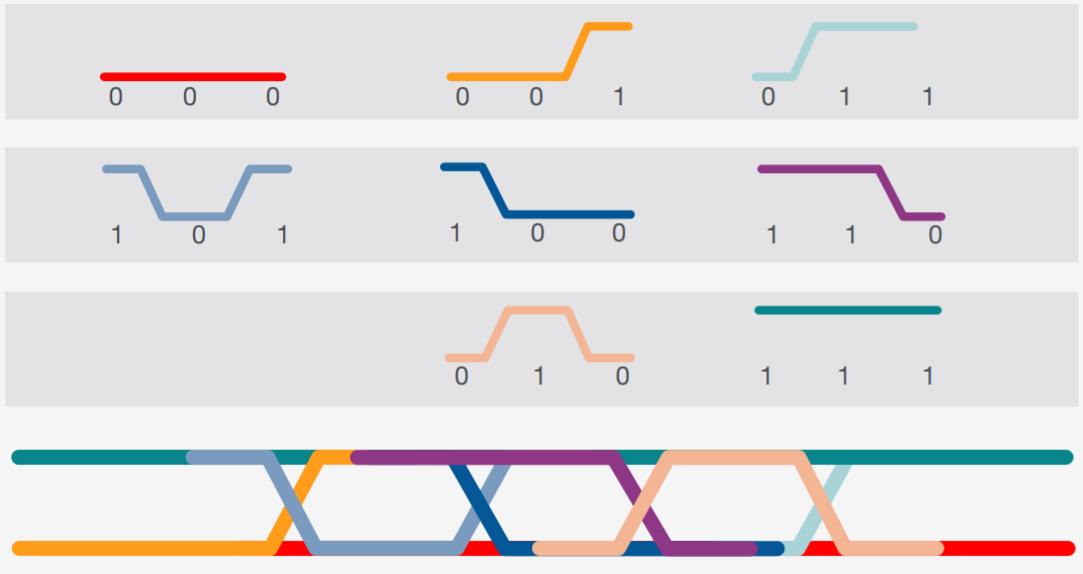
The eye diagram uses color grading to display the frequency of the signal passing through different areas in the graph, which provides another way to view the TIE frequency of time interval error. By testing the opening degree through the eye diagram, you can roughly see how much jitter there is. The greater the opening degree of the eye diagram, the smaller the jitter in the signal. The smaller the opening degree, the more it will shake.
The Time Interval Error TIE (Time Interval Error) represents the variation of each valid edge of the clock relative to the ideal position.
四、What performance indicators can be seen from the eye diagram?
When evaluating whether an eye diagram is good or bad, there are usually some common measurement indicators, such as eye height, eye width, jitter, duty cycle, etc., as shown in the above figure. By characterizing different parts of the eye, one can quickly determine and qualitatively identify the problem of the signal. For instance, the area above and below the intersection point of the eye diagram transition can represent the duty cycle. If the proportion of the upper and lower areas is asymmetrical, it indicates that there might be a problem with the result of the duty cycle.
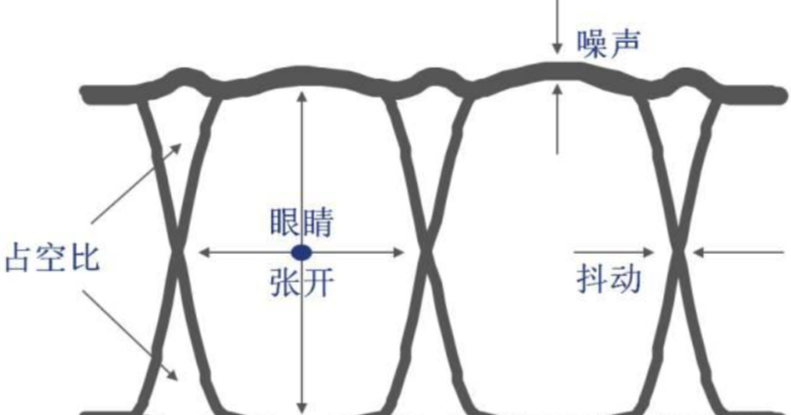
Different eye diagrams can reflect different signal qualities. Experienced engineers can detect from the eye diagram whether there is reflection caused by impedance mismatch in the signal and whether a certain jitter component is too large, and even know how to optimize the quality of the eye diagram. Overall:
The opening degree of the eye diagram is associated with jitter and bit error rate (BER).
The larger the eye diagram is opened, the greater the allowable error for noise and jitter.
The larger the eye diagram is opened, the better the receiver's judgment sensitivity is.
The width of the parietal, fundus and transition areas indicates a decrease in the receiver's judgment sensitivity
五、How to evaluate the quality of an eye map?
In fact, when evaluating the quality of eye diagrams, two important criteria are generally followed:
- The eyes should be large. If there is an eye diagram template, then using the template as the pupil, the Margin of the white part of the eye must be sufficient.
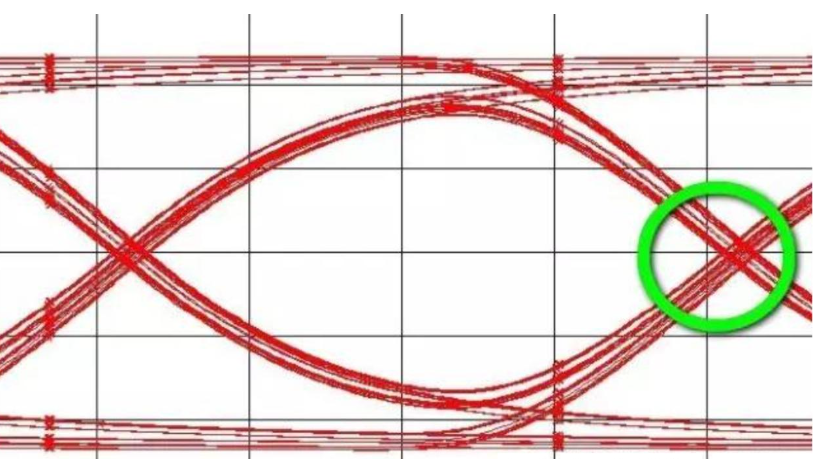
2. As shown in the figure, the crossed part between the red and green circles must be as small as possible, preferably a single point, because this represents jitter. If it is too large, it will cause an increase in the bit error rate. The smaller the jitter, the better the signal quality and the lower the probability of bit error.
 Previous