Submit


Characteristics of Unidirectional ESD diodes -ASIM
 2025.09.01 00:00:00
 170
170





Analysis of the Core Characteristics and Engineering Applications of Unidirectional ESD Diodes
一、Structural characteristics and working principle
1. Asymmetric PN junction design
- The cathode is clearly marked: Unidirectional devices adopt a single PN junction structure (anode-P region/cathode-N region), and the cathode polarity (color ring/groove) is clearly marked on the package surface.
- Current path:
- Forward conduction: Conducts when the signal voltage is greater than VF (typical VF=0.7V)
- Reverse clamping: Electrostatic pulse triggers avalanche breakdown (response time < 1ns)
2. Voltage response curve
| Status | Voltage range | Current characteristic |
|---|---|---|
| Off state | 0<V<VRWM | IR<0.1μA |
| Avalanche zone | VBR±10% | Dynamic resistance: 0.2Ω |
| Clamping state | V>VBR | VC≤ clamping voltage |
| (Note: VRWM= Reverse cut-off voltage, VBR= Breakdown voltage, VC= Clamping voltage) |
二、Core performance advantages
1. Precise voltage control
- Breakdown accuracy: ±5% tolerance (±10% for bidirectional devices)
- Case: The clamping voltage of ESD5D080TA in a 5V system is ≤9V (measured 8.2V@8kV ESD)
2. Ultra-low parasitic parameters
- Junction capacitance: 0.2-0.8pF (Supports USB4/HDMI2.1 and other interfaces > 10Gbps)
- Dynamic resistance: 0.2-0.5Ω (5 times lower than TVS, energy absorption efficiency increased by 40%)
3. Nanosecond response
- Trigger delay: 0.3 to 0.8ns (meeting the IEC61000-4-2 requirement of rising edge < 1ns)
- Measured data: The response time of ESD3V3D500TATA under 30kV ESD impact is 0.5ns
三、The key difference from bidirectional devices
| Parameter | Unidirectional ESD diode | Bidirectional ESD diode |
|---|---|---|
| Polarity requirements | It is necessary to distinguish between the Yin and Yang poles | Non-polar |
| Leakage current | <0.1μA@VRWM | <0.5μA@VRWM |
| Dc system compatibility | Excellent (Anti-mis-trigger | A series resistor is required. |
| Failure mode | 95% short-circuit failure | 70% short circuit /30% open circuit |
四、Engineering Selection Guide
1. Voltage matching principle
VBR ≥ 1.2 × VCC_max
- Case:
- 3.3V system → Select ESD3V3D500TATA (VBR=4.0V)
- 5V system → Select ESD5D080TA (VBR=6.4V)
2. High-speed interface layout specification
- The 3W rule: The distance between the device and the interface ≤ signal wavelength /10
- USB3.0 (5GHz) : Cable length ≤3mm
- Gigabit Ethernet: Trace length ≤5mm
3. ESD level matching
| Protection grade | Test standard | Recommended model |
|---|---|---|
| IEC61000-4-2 L4 | ±15kV air /±8kV contact | ESD24D003TA |
| Automotive grade AEC-Q100 | ±30kV multiple pulses | ESD36A150TA |
五、Typical application cases
1. Mobile phone USB-C port protection
VBUS ──┬── TVS(Power grade protection)
    │
 D+/D- ─┴── ESD5D080TA(Data cable protection)
Key design points:
- The area of the grounding copper foil is ≥10mm²
- The distance between TVS and ESD devices is greater than 2mm (to prevent coupling interference)
2. Industrial RS485 interface protection
Line A ────┤≡ESD24D003TA├── GND
Line B ────┘(Cathode grounding)
Failure prevention:
- A 10Ω resistor is connected in series for current limiting
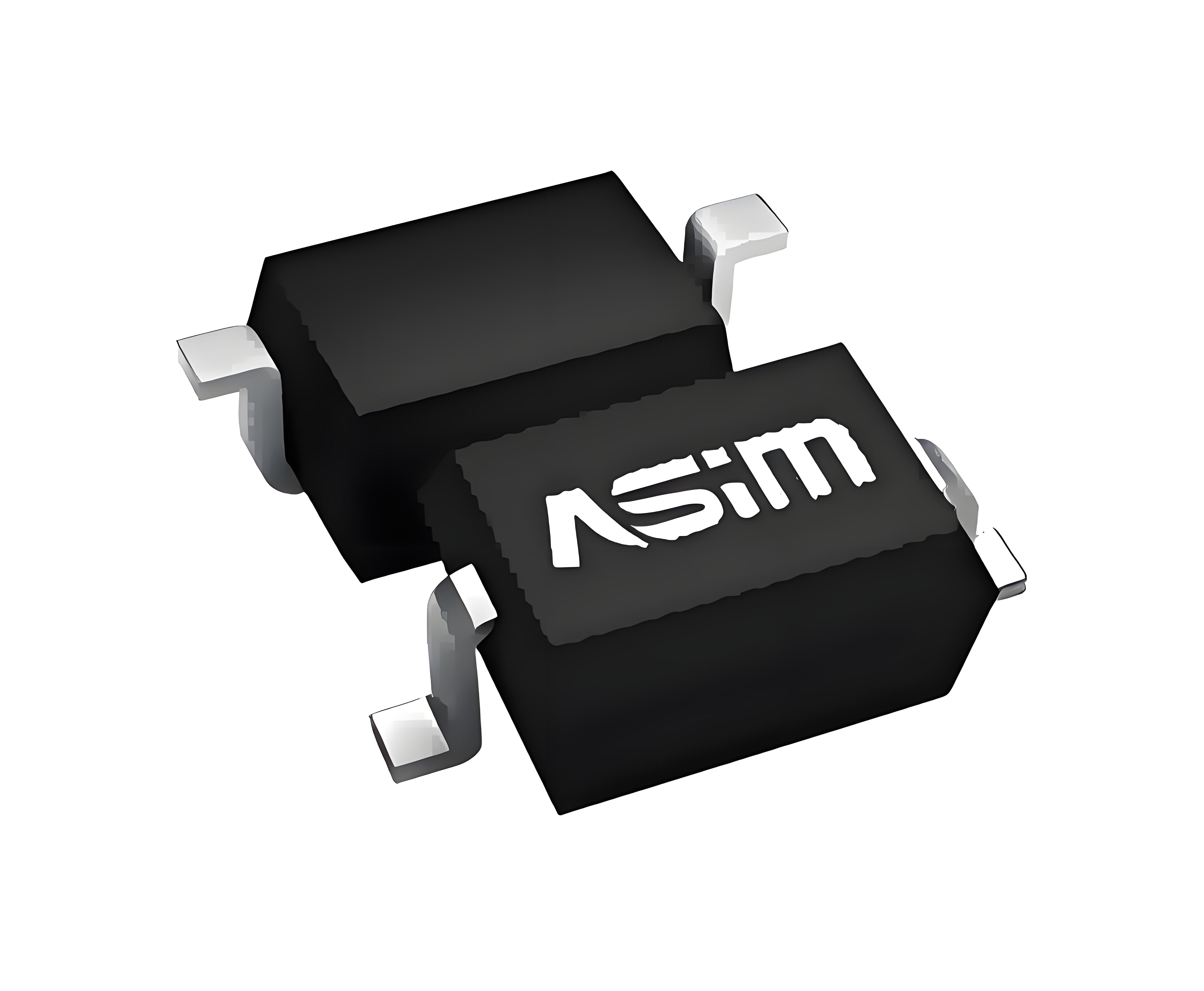
- The SOT-23 package is adopted to enhance heat dissipation
六、Failure Analysis and prevention
1. Typical failure mode
- Overcurrent burnout: ESD devices are mistakenly used at power ports (such as using ESD5D080TA to protect 12V power)
- Signal distortion: Using high-capacitance TVS (such as 50pF devices, causing eye diagram closure) on interfaces with a capacitance greater than 1Gbps
2. Accelerate life test data
| Test conditions | Failure period | Failure mechanism |
|---|---|---|
| 8kV ESD×1000 times | More than 500 times | Cathode metal migration |
| 10A surge impact | Single failure | The PN junction melts |
Conclusion: Unidirectional ESD diodes, with their precise voltage control and ultra-fast response characteristics, have become core components for electrostatic protection in high-speed electronic systems. When selecting the type, the three principles of "voltage matching, capacitor adaptation, and layout optimization" must be strictly followed in order to achieve the maximum protective effect.
 Previous