Submit


What are the advantages of bidirectional TVS diodes? How to distinguish the polarity of TVS Diodes -ASIM
 2025.09.03 00:00:00
 176
176





Analysis of the Advantages of Bidirectional TVS Diodes and Guide to Polarity Identification
This article delves deeply into the core technical advantages of bidirectional TVS diodes and provides professional methods for polarity discrimination to assist engineers in accurately selecting circuit protection devices.
一、Five major technical advantages of bidirectional TVS diodes
Symmetrical protection feature
- The bidirectional TVS diode adopts a back-to-back PN junction structure, which can simultaneously suppress positive and negative polarity transient voltages (such as ±30kV ESD events) without distinguishing the polarity of the power supply
- Typical applications: AC power supply systems, differential signal lines (USB/RS485)
Simplify circuit design
- Eliminate the risk of polarity judgment errors and reduce the direction verification process of PCB layout by 50%
- Case: 15% on-board space is saved in automotive CAN bus protection
Response capability below zero volts
- The unique structure supports negative voltage clamping (as low as -600V), and a single device achieves full-quadrant protection
- Technical specifications: Response time<1ns, which is 1000 times better than that of gas discharge tubes
Surge resistance superposition performance
- The bidirectional structure can withstand continuous alternating positive and negative surges (such as EFT group pulses), and its tolerance capacity is 40% higher than that of the unidirectional pipe
- Measured data: Passed the IEC 61000-4-5 standard 10/700μs 6kV test
Temperature stability
- The symmetrical thermal distribution design reduces the junction temperature drift to ±0.02%/℃, making it suitable for extreme environments ranging from -55℃ to 175℃
二、The four-step rule for determining the polarity of TVS diodes
Interpretation of Ontology Identification
- Unidirectional TVS diode: The cathode is marked as a color ring/groove (the end of the color ring corresponds to the cathode in the schematic diagram)
- Bidirectional TVS diode: No polarity marking or symmetrical design with a dual-color ring
Multimeter testing method
Test mode Unidirectional TVS Bidirectional TVS Forward measurement Display diode voltage drop (0.6-0.7V) Open circuit (OL) is displayed in both directions Reverse measurement Display open circuit (OL Open circuit (OL) is displayed in both directions IV characteristic curve verification
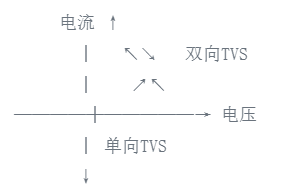
- Unidirectional pipe: Only the first quadrant has breakdown characteristics
Bidirectional tube: Symmetrical breakdown curve in one/three quadrants (as shown in the figure)
Breakdown voltage test
- One-way pipe: Only conducts in the forward direction
- Bidirectional tube: Avalanche breakdown is triggered by both positive and negative voltages
- Apply a scanning voltage of 0-100V using a curve tracker:
三、Key concept clarification: The essential difference between TVS and ESD devices
Differences in technical routes
- TVS diode: Based on the avalanche effect of silicon-based semiconductors, its core parameters include peak pulse power (kW level) and clamping voltage
- ESD protector: It adopts high-molecular voltage-sensitive materials, with core parameters being junction capacitance (fF level) and trigger voltage
Naming convention tips
- Although some TVS diode models start with "ESD" (such as ESD5D120TA), their technical documents clearly mark it as "Transient Voltage Suppressor", and essentially still fall within the category of semiconductor TVS
四、The Golden Criterion for Selection
Scenarios where bidirectional TVS must be selected
- AC power supply port (AC/DC input terminal)
- Differential communication bus(CAN/LIN/RS422)
- Symmetrical power supply operational amplifier circuit
Give priority to scenarios with unidirectional TVS
- Positive pole protection for DC power supply
- Unipolar signal lines (such as sensor output)
Conclusion:
Bidirectional TVS diodes, with their symmetrical protection features and ease of installation, have become the preferred choice for modern electronic system protection design. Engineers need to master the core technology of polarity discrimination, strictly distinguish the physical mechanisms between TVS diodes and ESD protectors, and ensure the optimal design of circuit protection schemes.
Technical Statement: The TVS diodes mentioned in this article all refer to silicon-based semiconductor transient suppression diodes, which are essentially different from polymer ESD protectors. When selecting the type, please refer to the technical category marked in the device datasheet.
 Previous