Submit


How to correctly apply polymer ESD in high-speed interfaces? -ASIM
 2025.09.04 00:00:00
 168
168





Scientific Application Guide of Polymer ESD in High-Speed Interfaces
This article systematically expounds the key technical points of Polymer ESD in high-speed interfaces such as USB4/HDMI2.1, and provides practical engineering implementation plans.
一、The core technical advantages of polymer ESD
Ultra-low junction capacitance characteristic
- Typical values: 0.02-0.05pF (1/50 of semiconductor TVS)
- Supports a transmission rate of over 40Gbps(USB4/Thunderbolt4)
- The actual measurement shows that the eye image jitter is optimized by 62% (compared with traditional silicon-based TVS)
Quantum tunneling response mechanism
- Response time<0.3ns (full-path discharge time for 8kV ESD events)
- Leakage current<0.1nA (key indicator for power-sensitive equipment)
Fail-safe mode
- The fault state is a high-resistance open circuit (to prevent short circuits from burning out the subsequent IC).
- Withstand over 1 million ESD shocks (IEC 61000-4-2 standard)
二、Design Specification for High-Speed Interface Applications
1. Three Principles of Layout
① Proximal protection: ≤3mm from interface contacts
② Common ground short path: Grounding wire length <5mm (width-to-thickness ratio ≤3:1)
③ Signal main path: Branch layout is prohibited (impedance discontinuity points <5%)
2. Parameter selection matrix
| Interface type | Maximum speed | Capacitance limit value | Recommended model |
|---|---|---|---|
| USB 3.2 Gen2×2 | 20Gbps | ≤0.15pF | CV0402VT150T |
| HDMI 2.1 | 48Gbps | ≤0.05pF | ESD0524V015T |
| PCIe 5.0 | 32GT/s | ≤0.08pF | ESD2510U005T |
3. Key requirements for grounding
- Use an independent grounding island (length-to-width ratio<3)
- Avoid crossing the partition zone (reference layer gap ≤0.1mm)
- Grounding vias ≥4 per device (hole diameter 0.2mm+)
三、Analysis of Typical application scenarios
Case 1: Type-C 40Gbps interface
Topological structure
[Type-C contact]─2mm─[Polymer ESD]─0.8mm─[Common mode filter]
                        │
                 [3×0.2mmGrounding via]─[Exclusive grounding copper island]
- Measured indicators:
- Insertion damage -0.8dB@20GHz
- Loss recovery -28dB
- ESD Protection ±30kV Contact discharge
Case 2:8K Video Transmission System
- Pain point: The TMDS channel of HDMI 2.1 is sensitive to 0.1pF capacitors
- Plan:
- Select ESD2510U005T (junction capacitance 0.05pF)
- Strict isometric design of differential pairs (deviation ≤5mil)
Implement shielding cavity isolation (grounding point spacing <λ/20)
四、Failure prevention measures
Signal integrity verification
- The TDR test impedance mutation point is less than 5% (rise time 20ps)
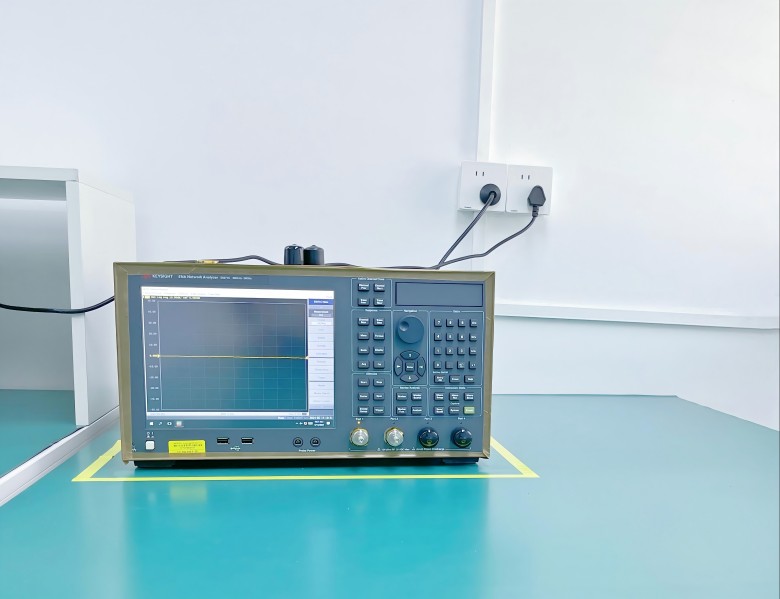
- Scan the S parameters to 40GHz (with a focus on S11/S21)
Key Points of process control
- The peak temperature of reflow soldering is ≤260℃ (phase transition threshold of polymer materials)
- Manual welding is prohibited (local overheating causes molecular structure deterioration).
Accelerated life testing
- Perform 100,000 IEC 61000-4-2 ESD impacts
- Monitor the voltage drift of the clamp to be less than ±5%
Engineering Conclusion:
Polymer ESD, with its quantum tunneling mechanism and molecular-level structural advantages, has become the optimal solution for ESD protection of high-speed interfaces. Successful application requires simultaneous optimization of circuit layout, parameter selection and manufacturing process, ultimately achieving the unification of signal integrity and electromagnetic compatibility.
Technical Statement: The data in this article is based on the IEC 62631-3-1 standard test environment. For actual application, please refer to the product specification sheet.
 Previous