Submit


TVS Diode Failure Mode Analysis: Design Guide for Protection Differences between Short Circuit and Open Circuit -ASIM
 2025.09.06 00:00:00
 197
197





Analysis of TVS Diode Failure Modes: Differential Design of Short-circuit and Open-circuit Protection
一、The essential differences in the failure mechanisms of TVS diodes
The failure of TVS diodes (Transient Voltage suppression diodes) mainly manifests in two modes:
1. Short-circuit failure
When the transient overcurrent exceeds the tolerance limit of the TVS chip, the PN junction undergoes thermal breakdown, causing the device impedance to approach zero. At this point, the fault current continuously passes through the TVS, which may cause the circuit board to burn out or even lead to a fire.
2. Open-circuit failure
When subjected to a single ultra-high energy surge (such as a lightning strike), the internal bonding wires of the TVS melt, resulting in a complete open circuit. At this point, the subsequent circuit is completely exposed to the risk of overvoltage, causing hidden damage to the IC.
Key data support:
Short-circuit failure accounts for approximately 65% (IEC 61643-321 statistics)
The voltage at the moment of open-circuit failure can reach 8 to 10 times the normal operating voltage
二、Comparison of the circuit effects of failure modes
| Failure type | Fault characteristics | System risk level |
|---|---|---|
| Short circuit | Impedance≈0Ω,Continuous conduction | (立即性危害) |
| Open road | Impedance→∞,The protective function has been completely lost | (隐蔽性危害) |
Typical fault scenarios:
- Short-circuit failure: Continuous overcurrent in the power supply system causes uncontrolled temperature rise
- Open circuit failure: The MCU experiences occasional resets after a lightning strike event
三、Differentiated protection design strategy
3.1 Key points of short-circuit protection design
Fuse Cooperative Protection (Core Solution)
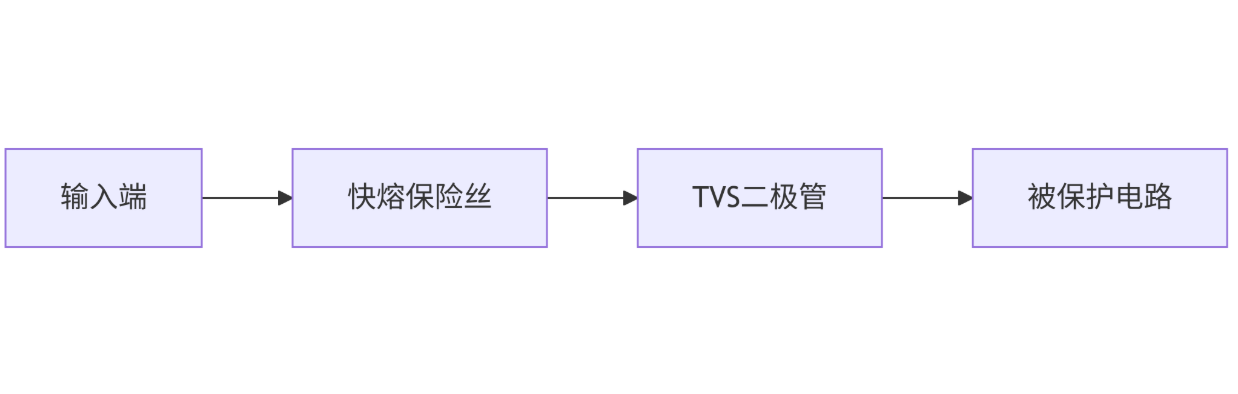
- Selection criterion: The I²t value of the fuse is less than the TVS withstand energy value
- Layout requirements: The distance between the fuse and the TVS should be no more than 5mm (to reduce the inductance of the loop)
3.2 Key points of anti-open road design
Redundant parallel architecture
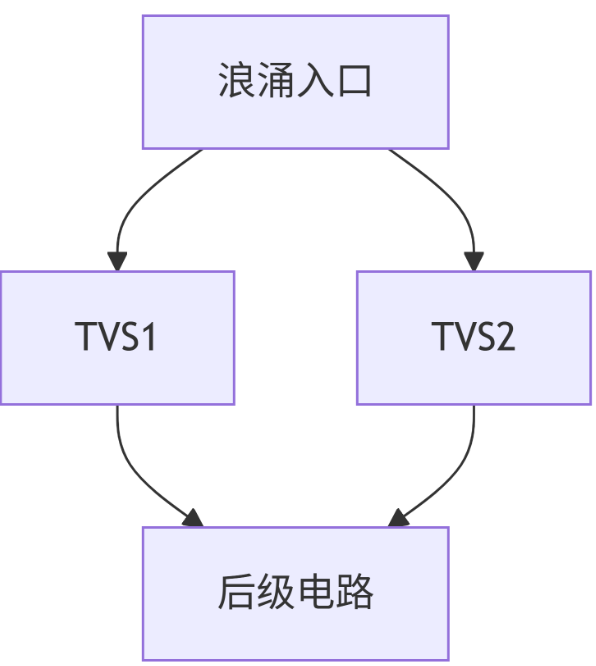
- Redundancy coefficient: Parallel connection of devices with a 30% increase in single-tube current-carrying capacity
- Current-sharing design: Symmetrical wiring ensures even current distribution
四、Key parameters for TVS diode selection
To achieve effective protection, four major parameters need to be focused on:
- Clamping voltage Vc
The requirement is: Vc < maximum withstand voltage of the protected IC ×0.9 - Peak pulse current Ipp
Calculation formula: Ipp > Expected surge current × Safety Factor (1.2-1.5) - Proportion of failure modes
Preferred devices with an open circuit/short circuit ratio of 7:3 (MIL-STD-750F standard) - Thermal resistance parameter
The RθJA of surface mount TVS should be ≤80℃/W (to prevent thermal runaway)
五、Typical application scenario protection solutions
Automotive electronic system protection architecture
[Battery] → [60A fuse] → [33V TVSArray] → [ECU]
         ↗[RedundancyTVS]
- Complies with ISO 16750-2 standard
- The dual-path design takes into account both load ejection and electrostatic protection
Industrial RS485 port protection
[A/B line] → [10ΩResistance] → [6.5V TVS] → [Transceiver]
         ↗ [PTC Self-resetting fuse]
- Resistance and PTC form a dual current limit
- The TVS clamping voltage needs to be lower than the transceiver damage threshold (usually 5.5V).
Conclusion
The failure mode protection of TVS diodes is the last line of defense for circuit reliability. By precisely matching fuse parameters, constructing a redundant architecture, and optimizing thermal design, the MTBF (Mean Time Between Failures) of the system can be significantly improved. It is recommended to conduct TVS failure mode simulation (TLP testing is recommended) during the design stage to achieve the design goal of fault-oriented safety.
 Previous