Submit






A TVS diode supplier audit should separate three questions: can samples start the engineering test, can production lots reproduce the approved result, and will a material, process, site, or specification change be reported before new material arrives? One successful sample lot does not answer all three.
Sample stock starts the experiment
Fast samples let an engineer measure surge and clamping behavior without waiting for a production reel. Cut tape, loose samples, and formal reels may carry different amounts of identity and traceability information. Photograph the received label and record the complete order code, package, source, lot, and applicable specification revision before soldering the parts.
The test record should include the sustained voltage range, pulse waveform, source impedance, polarity, count, interval, board revision, probe points, and failure criterion. Measure both the TVS terminals and the protected load when practical. Record leakage, standby current, temperature, and function after stress. These details turn a sample result into a baseline that another lot can repeat.
Keep five evidence groups with the sample:
product identity and specification revision;
supplier, shipment, label, lot, and packing information;
electrical source and waveform conditions;
board, probe, load, and software configuration;
pre-stress and post-stress electrical and functional state.
A production reel passes two gates
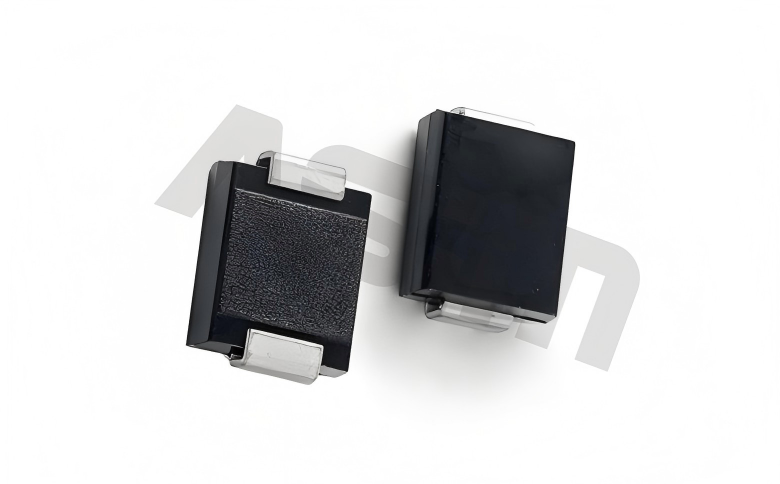
Electrical suitability and supply suitability are different gates. ASIM SMA04J24V illustrates the information needed for the electrical gate. The device uses an SMA/DO-214AC package and lists a 24 V reverse working voltage, a 26.7 to 29.5 V breakdown range, and 400 W peak pulse power. Under the stated conditions, it lists 10.3 A peak pulse current and 38.9 V maximum clamping voltage.
Those values are not interchangeable labels. The board’s highest sustained voltage must remain inside the off-state design window. The downstream circuit must tolerate the device-terminal clamping result plus PCB parasitic overshoot. The actual surge must be compared with the stated current, waveform, starting temperature, and pulse duration. Peak pulse power is not a continuous power rating.
The supply gate checks whether the production reel carries the approved complete code, packing orientation, label fields, specification revision, and traceable lot. It also checks normal lead time, replenishment, allocated versus shared inventory, and the process for an abnormal lot.
| Evidence | Approval question | Weak shortcut |
|---|---|---|
| Electrical window | Do VRWM, VBR, VC, IPP, and IR fit under aligned conditions? | Ranking parts by “24 V, 400 W” |
| Board result | What voltage reaches the load, and what changes after repeated stress? | Recording only whether the unit restarted |
| Production identity | Is the reel the same approved order code and packing? | Assuming the base name covers every suffix |
| Continuity | Can the source support pilot and volume timing? | Treating shared spot inventory as reserved stock |
A change notice belongs before the shipment
A supplier approval should state which changes require notification and who receives the notice. Wafer source, assembly material, test limit, manufacturing site, label format, specification revision, or discontinuance can affect customer review. The exact response depends on the change, but discovery at receiving inspection is too late.
Use a documented response path:
The supplier identifies the change, affected order codes, planned first shipment, and supporting comparison.
Engineering and quality classify the risk and define document review, sample tests, or system retests.
Purchasing prevents unapproved changed material from mixing with normal inventory.
The customer approves, rejects, or limits the changed version and updates the specification record.
Old and new lots retain a clear traceability boundary during the transition.
The notice process does not need to make every change dramatic. It needs to prevent a silent change from bypassing the evidence used for approval.
Qualify a second source before a shortage
A second TVS with the same working-voltage label and package can have a different breakdown tolerance, maximum clamping condition, dynamic resistance, leakage, thermal response, or packing. Qualify the alternative on the same board with the same waveform, source impedance, temperature, and functional criterion.
Start by freezing the non-negotiable boundaries: maximum sustained voltage, allowable protected-node peak, pulse definition, package space, temperature, leakage, and required production documentation. Compare candidates only after those conditions are aligned. A lower published clamping number is not a valid advantage if it was measured at a different current or waveform.
A second lot of the primary source should also repeat the most sensitive checks. The first lot establishes feasibility; later lots examine reproducibility through the intended production path.
Give the supply article a specific internal-link role
The ASIM TVS diode manufacturer hub carries the broader product, application, validation, and manufacturer information. This page concentrates on samples, production lots, change notices, and alternates. The internal link helps a reader move between engineering and supply questions without duplicating the same article under two titles.
Whether the candidate is ASIM or another supplier, the final approval record should connect product conditions, board evidence, packing, lot, delivery source, and change ownership. Production continuity is credible when the material that keeps arriving is the material that was actually tested.
Questions about TVS supplier and lot control
Can a successful sample lot be released directly to volume production?
No. Verify production packing, full suffix, lot traceability, a second-lot result, normal lead time, and the supplier’s change-notification process.
Which tests should follow a TVS product change notice?
The change determines the scope. Wafer, package, test-limit, or site changes may require specification review, leakage checks, key clamping measurements, and target-system functional retests.
Are two 24 V TVS diodes interchangeable?
Not by voltage label alone. Align breakdown tolerance, clamping current and waveform, leakage, package, temperature behavior, and board-level results.
Copyright notice:Copyright belongs to Shenzhen ASIM Electronics Co., Ltd. Please retain the author, source, and original URL when quoting or republishing.
Original URL: https://asim.com.cn/tvs-diode-supplier-lot-pcn-audit-en.html
 Previous