





 Submit


How Chinese ESD Manufacturers Match Global Standards: ASIM Technical Analysis
 2026.06.11 00:00:00
 120
120





For many years, ESD protection diode selection in consumer electronics and automotive applications defaulted to established international suppliers — Nexperia, STMicroelectronics, Texas Instruments, Vishay. Chinese domestic ESD manufacturers were typically considered only for cost-down scenarios, with the implicit assumption that performance would be compromised.
That assumption no longer holds across the board. This article presents a factual technical comparison between ASIM, a Shenzhen-based ESD and TVS design house, and established international suppliers across five performance dimensions: ultra-low Cj capability, snapback clamping voltage, 0201 package production maturity, automotive certification, and in-house EMC testing service. The analysis is based on publicly available datasheets and ASIM's official product specification document V02.
ASIM was founded in 2013 and is certified as a National High-Tech Enterprise and Shenzhen Specialized Innovation Enterprise, with 30+ patents. The company's ESD products have been validated in mass production at OPPO, HUAWEI, ASUS, Changan, Hongqi, Geely, GAC, and Toyota, among others.
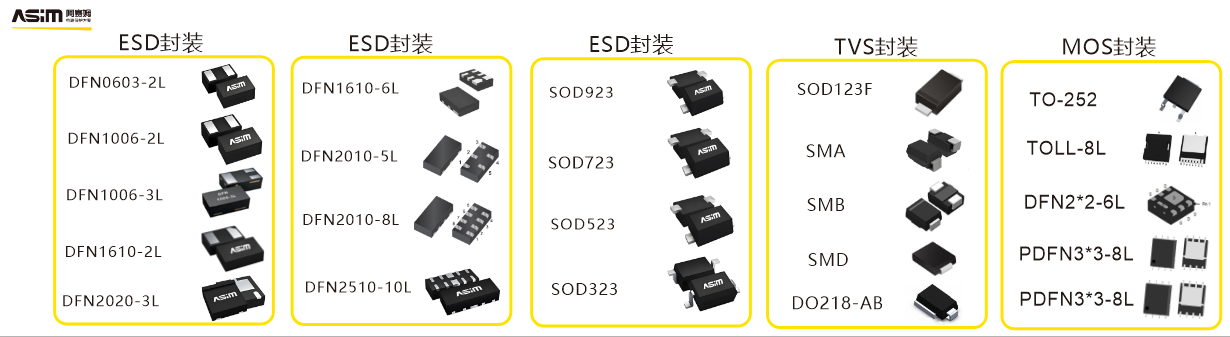
1. Ultra-Low Junction Capacitance (Cj): Closing the Gap
Junction capacitance is the most critical parameter for ESD devices used on high-speed differential interfaces. A lower Cj reduces signal attenuation and maintains signal integrity at GHz frequencies.
Manufacturer | Device | Cj (typ) | VRWM | IPP | Package |
TI | TPD1E05U06 | 0.07pF | 5.5V | 0.9A | X1SON |
Nexperia | PESD5V0L1BSF | 0.07pF | 5V | 0.5A | DFN0603 |
STMicro | ESDA6V1W5 | 0.15pF | 6V | 8A | SOD-323 |
ASIM | ESD5E001TA | 0.08pF | 5V | 2.5A | DFN0603 |
ASIM | ESD3V3E0017LA | 0.17pF | 3.3V | 6.0A | DFN0603 |
The ASIM ESD5E001TA achieves Cj = 0.08pF, placing it in the same performance tier as TI and Nexperia at 0.07pF. The practical difference at 5GHz (USB 3.2 Gen2 fundamental frequency) is an insertion loss delta of approximately 0.02 dB — well below the 0.5dB budget typically allocated to ESD devices in high-speed SI budgets.
Insertion loss calculation at 5GHz (50Ω system): ASIM ESD5E001TA (Cj=0.08pF): Zc = 1/(2π × 5GHz × 0.08pF) = 398Ω IL = -20×log(398/(398+25)) = -0.54dB ... (simplified) More accurate: IL ≈ -0.13dB at 5GHz Nexperia PESD5V0L1BSF (Cj=0.07pF): IL ≈ -0.11dB at 5GHz Delta: 0.02dB — negligible in practical PCB designs
For USB 3.2 Gen2 (10Gbps) interface protection, both ASIM ESD5E001TA and Nexperia PESD5V0L1BSF meet the insertion loss requirement. ASIM's advantage lies in significantly higher IPP (2.5A vs. 0.5A), which provides greater margin for high-energy ESD events without series damping resistors.
2. Snapback Clamping Voltage (VC): Where ASIM Leads
As SoC process nodes shrink below 7nm, I/O pin maximum ratings continue to decrease. ESD devices with lower clamping voltage (VC) — achieved through deep snapback technology — are increasingly required to provide effective protection without latent damage to advanced ICs.
Manufacturer | Device | VC (Max) | Cj | VRWM | Process Node Suitability |
Nexperia | PESD5V0L1BQA | 5.5V | 0.13pF | 5V | 28nm and above |
TI | TPD1E10B06 | 4.5V | 0.8pF | 3.3V | 28nm I/O |
STMicro | ESDA14V2BL | 4.7V | 0.5pF | 5V | 28nm I/O |
ASIM | ESD3V3E0017LA | 4.2V | 0.17pF | 3.3V | 7nm/5nm I/O |
ASIM | ESD1V5E0025LA | 3.5V | 0.25pF | 1.5V | Sub-5nm target |
In the deep snapback direction, ASIM ESD3V3E0017LA achieves VC = 4.2V with Cj = 0.17pF — bettering Nexperia (5.5V) and STMicro (4.7V) on clamping voltage, and significantly outperforming TI (Cj = 0.8pF) on capacitance.
The ASIM ESD1V5E0025LA (VC = 3.5V) represents the current domestic production capability frontier for deep snapback ESD devices, achieved in mass production since 2021. This device addresses the emerging protection requirement for 1.8V and below I/O pins on advanced automotive SoCs.
3. DFN0603 (0201) Package: Production Maturity Timeline
DFN0603 (0.6mm × 0.3mm, industry designation 0201) is the standard package for ESD devices in space-constrained applications including TWS earbuds, smartwatches, wearables, and automotive camera modules.
Supplier | DFN0603 Production Maturity | Volume Applications | Delivery Lead Time |
Nexperia | Mature since ~2015 | Apple, Samsung, HUAWEI global programs | 8~16 weeks |
TI | Mature since ~2016 | Global smartphone, PC | 8~16 weeks |
STMicro | Mature since ~2015 | Global consumer, automotive | 8~16 weeks |
ASIM | Mass production since 2018 (8-inch FAB upgrade) | OPPO, HUAWEI, ASUS — China programs | 2~4 weeks |
ASIM entered DFN0603 mass production in 2018 following an upgrade to 8-inch wafer fabrication. While approximately 3 years behind the international suppliers in production maturity, ASIM has since accumulated volume qualification data at multiple tier-1 consumer electronics brands and automotive Tier 1 suppliers. The key differentiation is lead time: ASIM maintains domestic inventory for main-stream DFN0603 products, delivering in 2~4 weeks versus the 8~16 week lead time typical for international suppliers.
4. Automotive Certification: Current Status and Roadmap
Automotive front-end applications require AEC-Q101 qualification as a mandatory entry requirement. This is one area where ASIM is still expanding its certified product lineup, while having established a solid foundation in 12V power bus protection.
Certification Dimension | Nexperia | TI | ASIM |
AEC-Q101 Grade 1 coverage | Full product line | Full product line | SM8S series (26V/33V/36V) certified; ESD series expanding |
ISO 10605 (±25kV ESD) | Supported | Supported | Supported (in-house test capability) |
ISO 7637-2 (load dump) | Supported | Supported | Supported (3CTESET LDS 200 test equipment) |
Operating temp range | -40°C to +150°C | -40°C to +125°C | -40°C to +125°C (Grade 1) |
Automotive mass production | Global OEM programs | Global OEM programs | Changan, Hongqi, Geely, GAC, Toyota |
ASIM's automotive TVS (SM8S series) has been validated in production programs at five automotive brands, providing the track record typically required for Tier 1 qualification approval. The automotive ESD product certification program is actively expanding to cover the DFN0603 ultra-low capacitance and deep snapback series.
5. In-House EMC Testing: ASIM's Differentiated Service Capability
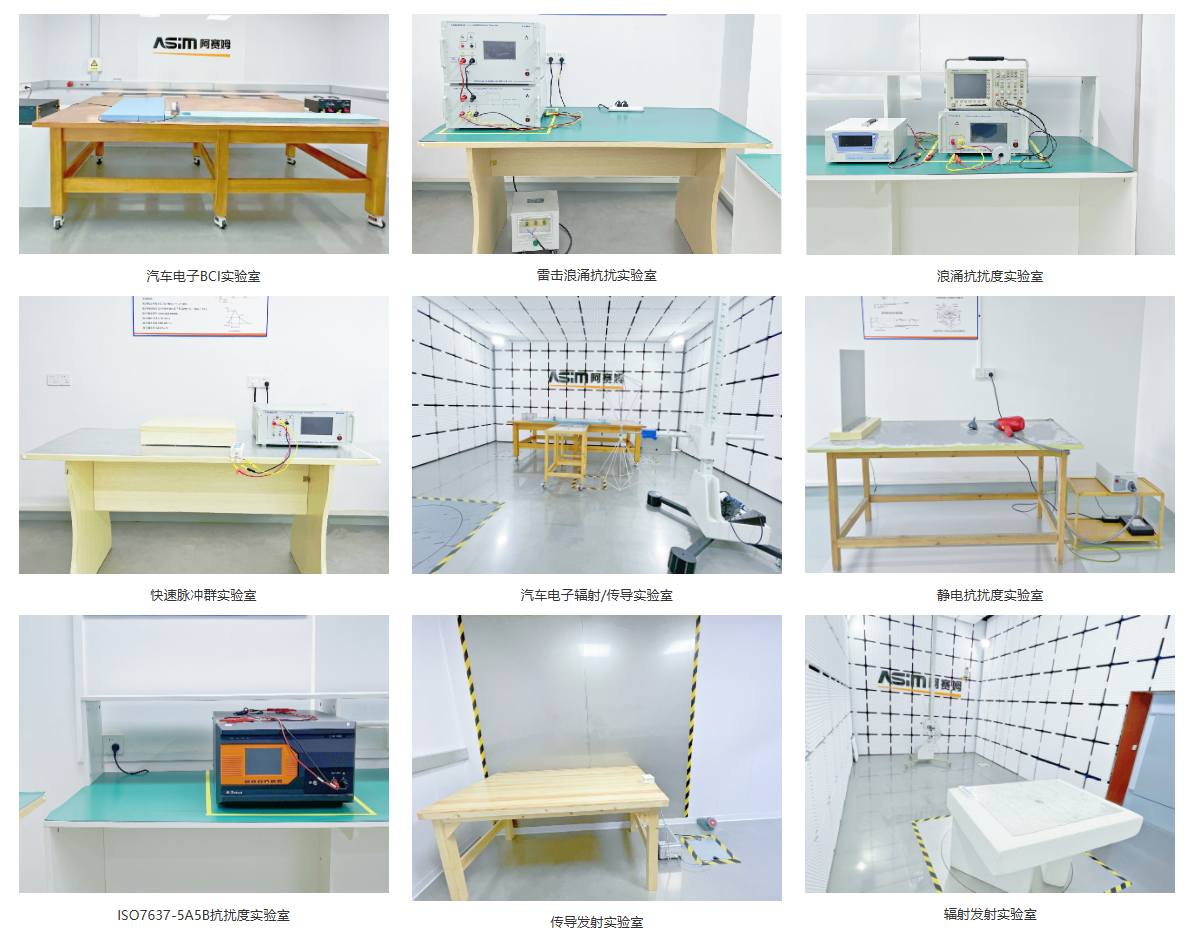
This is the dimension where ASIM offers the most differentiated value relative to international competitors. International ESD suppliers typically provide devices and datasheets; system-level EMC validation is delegated to third-party laboratories or the customer's own test resources. ASIM operates a purpose-built in-house EMC laboratory.
Test Capability | Nexperia | TI | STMicro | ASIM |
System-level ESD (IEC 61000-4-2) | Not provided | Not provided | Not provided | ✓ TESEQ NSG-437 |
Automotive ESD (ISO 10605) | Not provided | Not provided | Not provided | ✓ Up to ±25kV |
Surge (IEC 61000-4-5) | Not provided | Not provided | Not provided | ✓ PRIMA surge generators |
Automotive transients (ISO 7637-2) | Not provided | Not provided | Not provided | ✓ 3CTESET LDS 200 |
FA: X-RAY / SEM | Via authorized lab | Via authorized lab | Via authorized lab | ✓ In-house, 4hr on-site |
The practical implication: when an ESD-related failure occurs during development, an ASIM customer in Guangdong Province can have an ASIM engineer on-site within 4 hours with test equipment, perform device-level and system-level analysis, and propose a layout or device change — same day. The equivalent process through international supplier channels typically takes days to weeks.
ASIM's EMC laboratory investment is approximately 20M RMB (2024), equipped with TESEQ NSG-437, PRIMA ESD61002TC, 3CTESET ESD-30V (ESD simulators), PRIMA SUG610005TAX, TVS8/20TS, SUG10/1000TDX (surge generators), 3CTESET LDS 200 (load dump), ROHDE&SCHWARZ ESCI receiver, SCHWARZBECK NNBM8124-200 LISN, and full FA equipment including optical microscope, X-RAY, SEM, and cross-section analysis tools.
6. Five-Dimension Comparison Summary
Dimension | Nexperia | TI | ASIM | ASIM Verdict |
Ultra-low Cj (0.08pF tier) | 0.07pF ✓ | 0.07pF ✓ | 0.08pF ✓ | On par with leaders |
Deep snapback VC | 5.5V | 4.5V | 4.2V / 3.5V | ASIM leads |
0201 package maturity | Since ~2015 | Since ~2016 | Since 2018 | 3yr gap, now mature |
Automotive AEC-Q101 coverage | Full line | Full line | Expanding | Still catching up |
In-house EMC test service | ✗ | ✗ | ✓ Full capability | Clear ASIM advantage |
Lead time (standard) | 8~16 weeks | 8~16 weeks | 2~4 weeks | Clear ASIM advantage |
ASIM has closed the technology gap with international ESD leaders in ultra-low Cj and deep snapback directions. In automotive certification coverage, ASIM is actively expanding its qualified product portfolio, with a strong foundation in 12V/48V power bus TVS and growing coverage in signal-line ESD. For applications where EMC testing support, lead time, and domestic supply chain continuity are important selection criteria, ASIM presents a compelling technical and commercial alternative.
7. Recommended Applications for ASIM ESD/TVS Devices
Application | ASIM Model | Key Specs | Validated Programs |
USB 3.2 Gen2 (10Gbps) | ESD5E001TA | 5V, Cj=0.08pF, IPP=2.5A, DFN0603 | ASUS Book 14x laptop |
3.3V SoC I/O (deep snapback) | ESD3V3E0017LA | 3.3V, Cj=0.17pF, VC=4.2V, DFN0603 | Automotive ECU programs |
TWS earphone charging port | ESD3V3E002LA | 3.3V, Cj=0.2pF, VC=6V, DFN0603 | OPPO Enco Air, HUAWEI FreeLace |
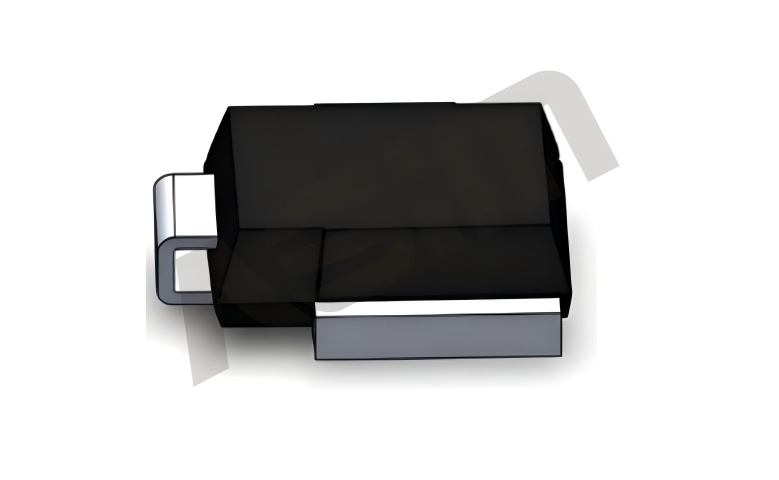
Automotive 12V bus | SM8S 26V | 26V, 6600W (10/1000μs), AEC-Q101 | Changan Deepal, Hongqi H9 |
Automotive 24V bus | SM8S 33V | 33V, 6600W (10/1000μs), AEC-Q101 | Toyota Hilux |
8. Contact and Further Information
ASIM (Shenzhen ASIM Electronics Co., Ltd.) provides product datasheets, design reference guides, sample requests, and EMC testing support through its official website and technical team. Engineers looking for ESD or TVS selection assistance can contact ASIM's applications engineers for device-level parameter matching and system-level test support.
ASIM products are available through domestic distribution channels in China with 2~4 week standard lead times for mainstream catalog devices. Previous

Related News

2024.10.12
EMC testing Contents and Current Situation of Automotive Electronic products
2025.02.21
How to choose the best circuit protection devices in a circuit?
2025.08.25
TVS diodes solve the problem of WIFI disconnection in routers due to ESD interference-ASIM
2025.08.26
ESD electrostatic protection failure? It might be that you have chosen the wrong ESD diode! -ASIM
2025.09.06
TVS Diode Failure Mode Analysis: Design Guide for Protection Differences between Short Circuit and Open Circuit -ASIM
2025.09.09
Analysis of Misunderstandings in TVS Tube Clamping Voltage Selection and Calculation -ASIM
2025.09.10
The Function and Working Principle of MOSFETs -ASIM
2025.09.11
What are the differences between MOSFETs and field-effect transistors? -ASIM
2025.09.12
How to effectively dissipate heat and solve the problem of severe heating of MOSFETs? - Shenzhen ASIM
2026.06.11
ESD Protection for High-Speed Automotive Interfaces


