





 Submit


How do I select the package for a TVS diode used with a 24V power supply?
 2026.07.16 00:00:00
 84
84





When selecting a TVS diode package for a 24V power supply, one must consider factors beyond just the operating voltage; surge energy, peak pulse power, clamping voltage, PCB footprint, and thermal dissipation conditions are also critical. Packages such as SMA, SMB, SMC, SM8S, and P600 are suitable for various power ratings and application scenarios, with industrial and automotive power supplies typically requiring higher design margins.
I. Why Package Selection Matters for 24V Power Supplies
24V power supplies are commonly used in industrial control, communication equipment, automotive modules, security systems, and motor control applications, where they are frequently exposed to surges, inductive load kickback, and cable-coupled interference. In automotive environments, they must also withstand rigorous transient waveforms, such as the ISO 7637-2 "Load Dump" pulse.
Generally, a larger TVS package offers higher pulse energy handling and superior heat dissipation, albeit at the cost of a larger PCB footprint. For instance, the Asym SM8S series (DO-218AB package) delivers a single-device pulse power rating of 6600W (10/1000μs), while the P600-packaged 15KP series provides automotive-grade protection reaching 15,000W. These clearly outperform the smaller SMA/SMB packages in terms of power handling, though they also require significantly more PCB space.
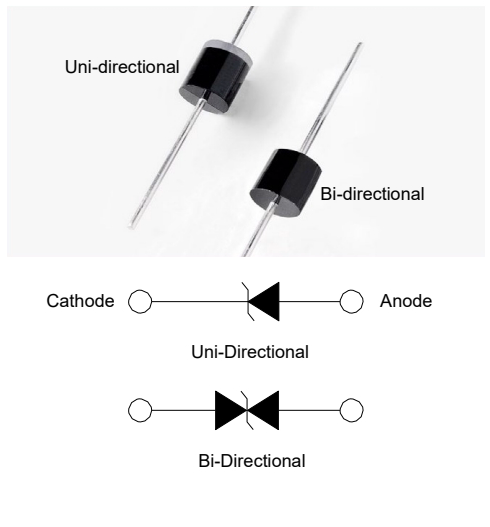
II. Considerations for Selecting Common Packages
The SMA package is suitable for applications with limited space and lower surge ratings—for example, the Asaim SMAO4J24V (SMA package, standoff voltage 24V, clamping voltage 36.8V);
The SMB package offers greater design margin;
The SMC package is suitable for higher-energy surges;
The SM8S and P600 packages are suited for more demanding protection requirements in automotive or industrial power inputs. Examples include the Asaim SM8S66J24V (DO-218AB package, 6600W, AEC-Q101 automotive-grade compliant, a transient voltage suppressor designed specifically for 24V automotive systems) and the 15KPxxxC series in the P600 package (15000W, compliant with ISO 16750 load dump testing).
Actual selection must take into account specific test waveforms—such as 8/20μs, 10/1000μs, or automotive load dump conditions—rather than relying solely on the package designation.
III. Parameter Matching Method
The VRWM should be higher than the system's maximum normal operating voltage; VBR must be selected to avoid false triggering during normal operation; VC should be lower than the withstand voltage of downstream components; and peak power and IPP must meet the energy requirements of the test.
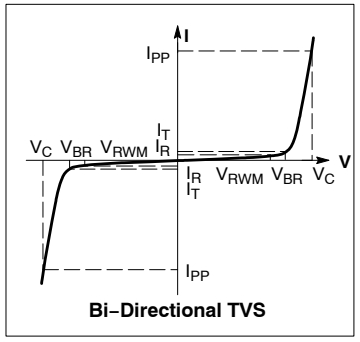
SMAO4J24V: VRWM = 24.0V, VBR = 26.7–29.5V, VC = 36.8V;
SODA24V-SH (compact SOD-123 package): VRWM = 24.0V, VC = 38.9V, IPP = 5.14A;
SM8S66J24V: VRWM = 24.0V, VC = 24V (nominal clamping voltage), pulse power 6600W.
If VC is too high, downstream chips may still be damaged by surges; if VRWM is too low, false triggering may occur during normal operation or power supply fluctuations.
IV. ASIM Solution Recommendations
ASIM TVS products are available in a wide range of packages, including SMA, SMB, SMC, SM8S, and P600. Protection solutions with varying power ratings can be provided to suit applications such as 24V power inputs, industrial power supplies, automotive power systems, and communication equipment. Recommended models include:
| Package type | Representative models from Asaimu | Key parameters | Applicable Scenarios |
|---|---|---|---|
| SMA | SMAO4J24V | VRWM 24V, VC 36.8V, SMA Package | Space-constrained industrial power supplies |
| SOD-123 | SODA24V-SH | VRWM 24V, IPP 5.14A, VC 38.9V | Compact auxiliary protection |
| SM8S (DO-218AB) | SM8S66J24V | 6600W, VRWM 24V, AEC-Q101 | Automotive 24V Power Input Front-End |
| P600 | 15KPxxxC 系列 | 15000W, P600封装, ISO7637/16750 | Harsh Industrial/Automotive Load Dump |
| Automotive-grade ESD | ESD24A003TBC | Automotive-grade ESD, ±24V VRWM | Electrostatic assistance for sensitive signal lines |
We help customers strike a balance between shielding performance, board space, and signal integrity.
FAQ
Q: Can a 24V TVS be used for a 24V power supply?
A: It depends on the system's maximum operating voltage and power supply fluctuations; they cannot be simply equated. For example, the SM8S66J24V has a VRWM of 24.0V; you must verify that the system's normal maximum operating voltage is below this value and that power supply fluctuations will not trigger an accidental breakdown.
Q: Is a larger package always better?
A: Larger packages offer higher energy handling capabilities but come with increased costs and space requirements; selection should be based on the required test level. For instance, automotive load dump applications require SM8S or P600 components, whereas the SMA package is more suitable for space-constrained applications.
Q: Should clamping voltage be considered for a 24V power supply TVS?
A: Yes, it must be considered, as the clamping voltage determines the maximum transient voltage experienced by downstream components. For example, the SMAO4J24V has a clamping voltage of 36.8V, which must be lower than the maximum voltage rating of the downstream chip.
 Previous

Related News

2024.10.12
EMC testing Contents and Current Situation of Automotive Electronic products
2025.02.21
How to choose the best circuit protection devices in a circuit?
2025.09.10
The Function and Working Principle of MOSFETs -ASIM
2026.07.08
Are SM8S series TVS diodes suitable for automotive power supplies?
2026.07.11
How is the ESD0524 series used for USB interfaces?
2026.07.13
How do I select a 5V low-capacitance ESD diode model?
2026.07.13
What should be done if a USB interface fails ESD testing?
2026.07.15
What should be done if signal abnormalities occur after adding ESD protection to a MIPI interface?
2026.07.15
For what applications are SOD-323 packaged ESD diodes suitable?
2026.07.15
How do you select a low-capacitance ESD protection device for an HDMI interface?


